
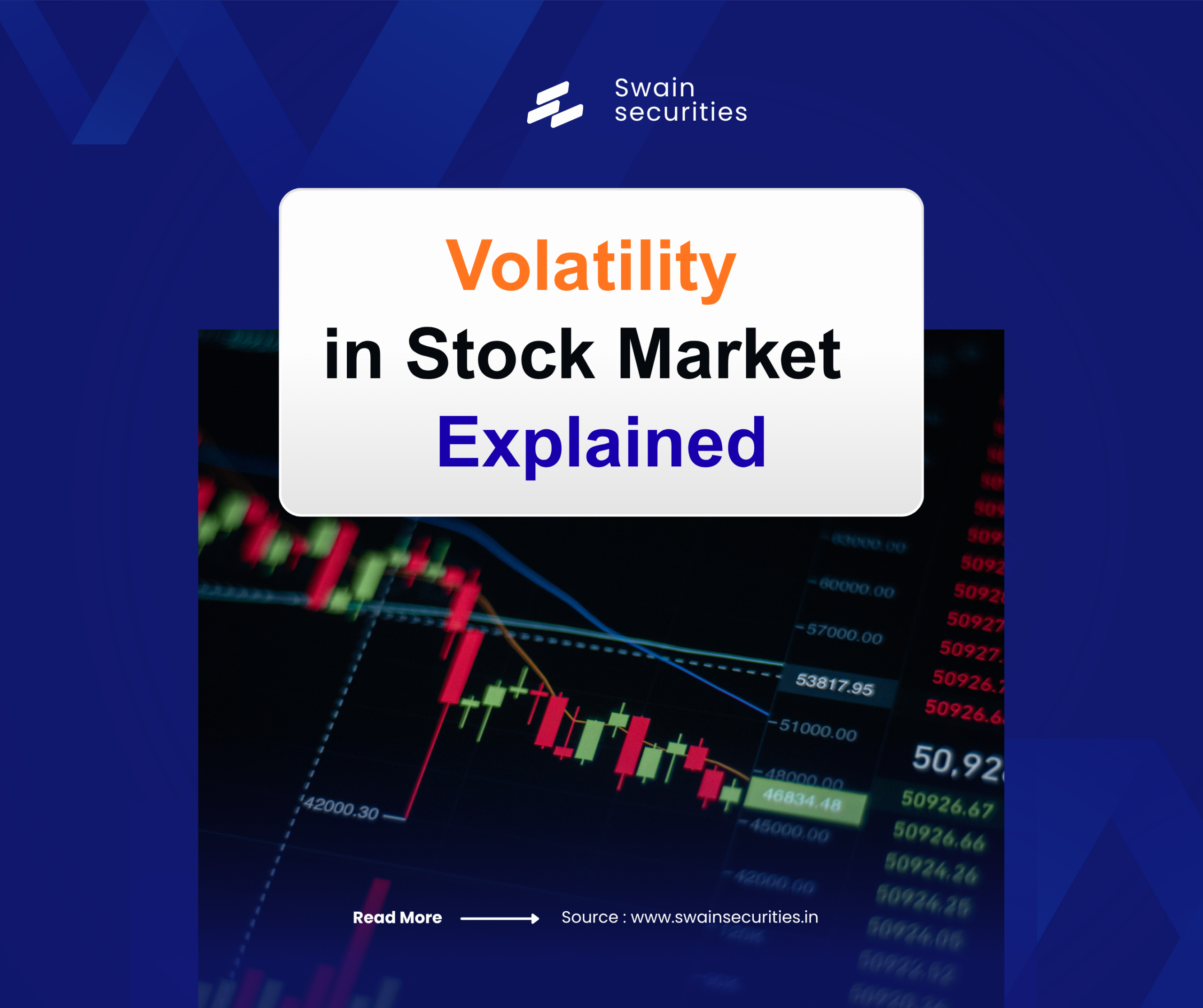
Volatility in the Stock Market: Meaning, Importance, Types and How Traders Can Use It
Volatility in Stock Market: Meaning, Importance, Types & Trading Guide
Learn about the significance of volatility in the stock market, how traders and investors are affected by it, and how to distinguish between high and low market volatility.
What Is the Stock Market’s Volatility?
Volatility in the stock market refers to how quickly and how much the price of a stock, index, or other financial asset moves up or down over a period of time.
When prices move sharply in a short period, the market is considered highly volatile. Volatility is deemed low when prices fluctuate slowly within a relatively narrow range.
For example, suppose a stock is trading at ₹500.
If it moves between ₹495 and ₹505 during the day, the movement is relatively small.
If it moves from ₹500 to ₹530 and then falls to ₹480, the stock is showing much higher volatility.
Therefore, volatility is mainly about the size and speed of price movements, not whether the price is moving upward or downward.
A volatile market can move strongly in either direction.
What is the significance of volatility in the stock market?
Volatility is important because it directly affects risk, trading opportunities, option prices, stop-loss levels and investment decisions.
Understanding volatility can help market participants prepare for larger-than-normal price movements.
1. Helps Understand Market Risk
Higher volatility generally means that prices can change significantly within a short period.
For instance, a trader who purchases a stock that has a high degree of volatility may experience a significant gain or loss within a few hours. Low volatility usually means price movements are comparatively smaller.
However, low volatility does not mean that an investment is completely safe.
2. facilitates traders’ trade planning
Volatility can help traders decide how much room to give a trade.
Consider a situation in which a stock moves only five times per day but suddenly moves fifteen to twenty. A stop-loss that was suitable during low volatility may become too tight during high volatility.
Therefore, traders can consider current volatility when planning:
Entry price
Stop-loss
Target price
Size of position Risk-to-reward ratio
3. Important for Options Trading
Volatility is particularly important for options traders.
Option prices are affected by several factors, and expected volatility is one of the important ones.
When expected volatility increases, option premiums can increase because the possibility of a larger price movement becomes greater.
This is why option traders should understand concepts such as:
Implied Volatility (IV)
Historical Volatility (HV)
Vega
Option premium
Expiration
Strike price
Volatility does not guarantee that an option buyer will make money. A trader can correctly predict high volatility and still lose money if the underlying price does not move sufficiently in the expected direction or if other factors work against the position.
Types of Volatility in the Stock Market
There are different ways to measure and understand volatility. Implied volatility and historical volatility are two frequently discussed concepts.
1. Volatility in the Past ( Historical Volatility )
The actual price changes that have taken place in the past are examined in terms of historical volatility.
For example, if a stock has experienced large daily price movements over the previous 30 trading sessions, its historical volatility may be relatively high.
Historical volatility can help traders understand how much an asset has moved historically.
However, past volatility does not guarantee future volatility.
2. Implied Volatility
Implied Volatility (IV) is mainly associated with the options market.
It represents the market’s expectation of how much the underlying asset may move in the future, as reflected in option prices.
When IV rises, option premiums can become more expensive, all else being equal.
When IV falls, option premiums can lose value, all else being equal.
This makes IV especially important for option buyers and sellers.
What Causes Volatility in the Stock Market?
Stock market volatility can increase because of many factors.
1. Economic News
Market movements can be sudden as a result of significant economic announcements.
Examples include:
Inflation data
Interest-rate decisions
Employment data
Economic growth figures
Government policies
2. Company News
Individual stocks can become highly volatile after important company-related announcements.
Some examples are:
Quarterly earnings
Management changes
Mergers and acquisitions
New merchandise Regulatory developments
Large orders or contracts
3. Global Events
International developments can also affect financial markets.
Wars, geopolitical tensions, major policy changes and global economic concerns can increase uncertainty and cause larger market movements.
4. Market Sentiment
Investor emotions can play an important role.
When investors become extremely optimistic, buying pressure can push prices higher.
When fear spreads through the market, investors may sell quickly.
This can result in sudden price movements.
5. Liquidity
Stocks with lower trading activity can sometimes experience sharper price changes when large orders enter or leave the market.
Highly liquid securities generally have more buyers and sellers available, although they can still become very volatile during major events.
What Effect Does Volatility Have on Traders?
Volatility can create both opportunities and risks.
For Short-Term Traders
Higher volatility can provide larger price movements and potentially more trading opportunities.
However, larger movements can also produce larger losses.
Therefore, traders should not look at volatility only as a way to make money. Risk management is equally important.
For Long-Term Investors
Investors with a long investment horizon might not be as concerned about volatility in the short term.
A good investment can fluctuate in price for a short time without affecting its long-term business fundamentals.
Nonetheless, investors should still be aware of the reasons for volatility and whether the underlying investment thesis is still valid.
For Option Buyers
High volatility can make option premiums more expensive.
If IV decreases after an option is purchased, the option premium can decline even if the underlying asset does not move much.
For Option Sellers
Option sellers often pay close attention to implied volatility because higher IV can mean richer premiums.
However, there is a reason for higher premiums: the market may be anticipating larger price changes. Therefore, option selling is not automatically safer simply because the trader receives premium.
How are traders able to gauge volatility?
There are several tools and indicators that can help traders understand market volatility.
1. Average True Range (ATR)
ATR is a popular technical indicator used to measure the average range of price movement over a selected period.
It can help traders understand whether an asset is currently experiencing relatively large or small price movements.
ATR does not tell you whether the price will rise or fall.
It mainly provides information about price movement and range.
2. Bollinger Bands
Bollinger Bands are another popular technical analysis tool.
When the bands become wider, it can indicate increased price volatility.
When the bands become narrower, it can indicate relatively lower volatility.
However, traders should not use Bollinger Bands alone to predict market direction.
3. Implied Volatility
Options traders commonly monitor IV to understand the market’s expectations about future price movement.
Comparing current IV with its historical levels can provide additional context.
Management of Risk and Volatility
When determining the size of a position, ignoring volatility is one of the biggest mistakes a trader can make. Consider two stocks:
Stock A: Normally moves around ₹5 per day.
Stock B: Normally moves around ₹20 per day.
Using exactly the same position size and stop-loss approach for both stocks may not be appropriate.
Before deciding how much capital to risk, a trader needs to take into account the typical movement of the security. Good risk management may include:
Using the right size for the position Setting a logical stop-loss
Limiting your use of force Maintaining a reasonable risk-to-reward ratio
avoiding decisions based on emotion limiting exposure in the event of unfavorable market conditions
Is High Volatility Good or Bad?
There is no simple answer.
High volatility can be an opportunity for traders, but it also increases the possibility of large losses.
For example, a day trader may prefer a market that moves significantly because there may be more trading opportunities.
On the other hand, a conservative investor may prefer a less volatile investment because large short-term price swings can be uncomfortable.
Therefore, whether volatility is “good” or “bad” depends on:
Trading style
Investment horizon
Tolerance for risk Position size
Strategy
Market conditions
Volatility in Options Trading
The options market is especially dependent on volatility. An option’s premium is influenced by several variables. Volatility is one of them.
When IV increases
Option premiums may rise, provided that no other factors change.
When IV decreases
Option premiums can decrease, assuming other factors remain unchanged.
This creates an important circumstance for buyers of options: Being right about the direction of the market is not always enough.
For example, an option buyer may purchase a call option expecting the stock to rise. The option may still lose value even if the stock moves slightly higher than anticipated and implied volatility decreases. Option traders need to understand volatility and Greeks together for this reason.
The VIX and volatility The VIX
often called the market’s “fear gauge,” is a well-known measure related to expected volatility in the U.S. stock market.
It is derived from S&P 500 index options and is designed to reflect expected near-term volatility.
A rising VIX generally indicates that investors are pricing in greater uncertainty or expected market movement.
However, VIX should not be interpreted as a simple signal that the market must fall.
Similarly, a low VIX does not guarantee that the market cannot suddenly become volatile.
Volatility Does Not Predict Direction
For novices, this is an extremely important point.
You can learn about the potential size of price movement from volatility, but not necessarily its direction. Suppose a stock moves from ₹100 to ₹120.
That is a 20% upward movement.
If another stock moves from ₹100 to ₹80, that is a 20% downward movement.
There has been significant movement in both stocks.
Therefore:
Volatility = How much the price moves
Trend/Directions = Which way the price moves
These are different concepts.
Common Mistakes Traders Make About Volatility
First error:
Thinking that a high volatility will cause the price to rise A market with high volatility is not bullish. The price can move sharply upward or downward.
Second error:
Neglecting Position Size Large price swings combined with large positions can result in significant losses.
Mistake 3:
Treating IV as a Direction Indicator
High IV does not mean the stock will definitely rise or fall.
It mainly reflects expectations about future movement.
Mistake 4:
Using the Same Stop-Loss Everywhere
The normal price ranges of different securities vary
Mistake 5:
Thinking That Profits Are Guaranteed by Volatility Volatility creates movement, not guaranteed profits.
A trader still needs a valid strategy, disciplined execution and proper risk management.
How Beginners Can Use Volatility in Trading
Beginners do not need complicated mathematical formulas to start understanding volatility.
A simple approach is:
Step 1: Observe the normal daily movement of the stock.
Step 2: Determine if the current movement is disproportionately high or low.
Step 3: Use tools such as ATR or Bollinger Bands for additional context.
Step 4: If trading options, examine implied volatility.
Step 5: Adjust position size according to risk.
Step 6: Before entering a trade, always determine the maximum loss that is acceptable.
This approach can help traders avoid making decisions based only on emotions
Frequently Asked Questions About Stock Market Volatility
What exactly is stock market volatility?
Volatility is the degree to which the price of a stock, index or other financial asset changes over time. Large and rapid price movements indicate higher volatility, while smaller movements indicate lower volatility.
Is volatility good for traders?
Volatility can create trading opportunities because prices move more. However, it can also increase the size of potential losses. Therefore, volatility should be managed rather than simply chased.
Is high volatility risky?
Generally, high volatility means greater potential price movement and therefore can increase short-term risk. The asset, position size, leverage, and trading strategy all play a role in the actual risk.
What is the difference between volatility and risk?
Volatility measures the size or variability of price movements. The possibility of not achieving an expected outcome or losing money are both examples of risk. Investment risk and volatility can overlap, but they are not the same thing.
Is volatility important for option trading?
Yes. Because changes in implied volatility can have a significant impact on option premiums, volatility is especially important in options.
Does high volatility mean the market will fall?
No. High volatility does not tell you the direction of the market. Prices can move sharply upward or downward during periods of high volatility.
Which indicator is useful for measuring volatility?
ATR, Bollinger Bands and implied volatility are commonly used to understand different aspects of market volatility. Each tool has a different purpose and should not be treated as a guaranteed prediction tool.
Can volatility help in risk management?
Yes. Traders can adjust position sizes, stop-loss levels, and expectations regarding potential price movements with the assistance of an understanding of volatility.
Final Thoughts
Volatility is one of the most important concepts in the stock market, especially for active traders and options traders.
It helps market participants understand how much price movement they may need to deal with. High volatility can provide greater trading opportunities, but it can also increase the possibility of losses.
For beginners, the most important lesson is simple:
Do not fear volatility, but do not ignore it either.
Before entering a trade, understand the current market conditions, estimate the possible price movement and manage your risk accordingly.
For option traders, volatility becomes even more important because changes in implied volatility can affect option premiums significantly.
Ultimately, successful trading is not about predicting every market movement. It is about having a clear strategy, managing risk and making decisions based on evidence rather than emotions.
Learn : Option Trading Basics to Advance



Leave a Reply